Four Seasons Landscape

Landscape & Construction · MarylandCall 443-390-9273
Contact Four Seasons
Stormwater Management · Ponds, Basins & Swales

Facilities that work.
Kept that way.

Scheduled maintenance, inspections and restoration for stormwater ponds, bioretention basins and swales — for government and institutional facilities, and for the HOAs and commercial owners whose ponds and BMPs have to keep working and stay documented.

4.9★ on Google · 36 reviews·Woman-Owned · Certified Small Business·MHIC 112954·40+ years in Harford County
Stormwater Credentials
MS4 Stormwater Compliance Professional · Cert 2043Qualified Construction Stormwater Inspector · Cert 6335CBLP · Cert 4-00092MD Erosion & Sediment Control White Card · RPC004871SHA Yellow Card · 67329523
Why Facilities Fail

Built to be maintained.

A stormwater facility is an engineered system, not a landscaping feature. It was built to hold runoff, settle out sediment and filter what washes off roads and roofs before that water reaches a stream. It only keeps doing that job if somebody tends it — and most facilities nobody tends are already slipping.

The failure is quiet. Plantings take over or die back. Sediment and trash choke forebays and outfalls. And the turf on the banks gets mowed the way you'd mow a lawn — rutted by machines that don't belong on wet slopes, scalped too short to hold the soil — until the facility is damaged by the very crew meant to keep it tidy. Left long enough, neglect compounds into flooding, erosion and an expensive restoration.

Our rounds exist to stop that slide. Four Seasons crews maintain stormwater facilities for Baltimore City Government, Harford County DPW, Water & Sewer and Highways — and handle facility work for SHA and MDOT — the same scheduled care we'd put your pond or basin on: vegetation managed, structures kept clear, turf handled the stormwater way, and a paper trail that proves it.

A finished river-rock stormwater channel running between mulched beds of native plantings at a park bioretention facility
A river-rock channel through native plantings at a park bioretention facility — the system working the way it was built to. Harford County.
What We Do

Care for the whole facility.

Facility maintenance rounds

The standing schedule that keeps a facility functioning: vegetation care, weeding, mulch renewal and cleanouts at ponds, bioretention basins and swales, on a rhythm matched to the site — not a rescue visit after something's already failed.

Ponds & bioretention care

The plantings are the filter, so they're treated like working equipment: kept alive, kept in bounds, and replanted where beds have thinned out. Supplemental plantings and replantings go in on the rounds, before bare spots become erosion.

Swales, outfalls & structures

Channels, forebays, risers, drains, manholes and outfall aprons kept clear of sediment, trash and volunteer growth, with stone reset where it belongs. A blocked structure is how a working facility stops working.

Restoration & repair

A facility that's already degraded gets brought back to its engineered plans first — as a standalone project, for any facility type: government, institutional, HOA or commercial. Then it goes on rounds, so the restoration isn't money spent twice.

Facility turf, mowed right

Facility turf is not a lawn. Mowing it like one — heavy machines on wet slopes, grass scalped short — ruts banks and strips the cover that holds them. Our crews mow stormwater facilities the stormwater way, because the turf is part of the system.

Inspections & reporting

Hire us for a standalone inspection of your facility, or take inspections inside a maintenance contract — either way you get a straight read on its condition. And the work itself is documented: scope reports with before-and-after photos accompany our invoices, so what was done is on file.

On The Rounds

Facilities on the rounds.

Real facilities our crews maintain — ponds, basins, swales and the structures that connect them, photographed on regular rounds.

A stormwater pond outlet with a concrete headwall and still water reflecting trees in evening light
The outlet endA pond outlet and headwall on a maintained facility — structures checked, banks kept mowed, water sitting the way it should. Harford County.
A brick-lined trench drain with metal grates crossing a school entrance walkway, with mulched foundation beds beside it
Drainage at the doorA brick-lined trench drain carrying water across a school entrance walk, beds restored and mulched around it. Baltimore City.
Ornamental grasses growing in a mulched bioretention bed above a campus walkway, with a trench drain along the walk
The planting is the filterOrnamental grasses in a mulched bioretention bed above a campus walkway — kept full and in bounds so the bed keeps filtering. Baltimore City.
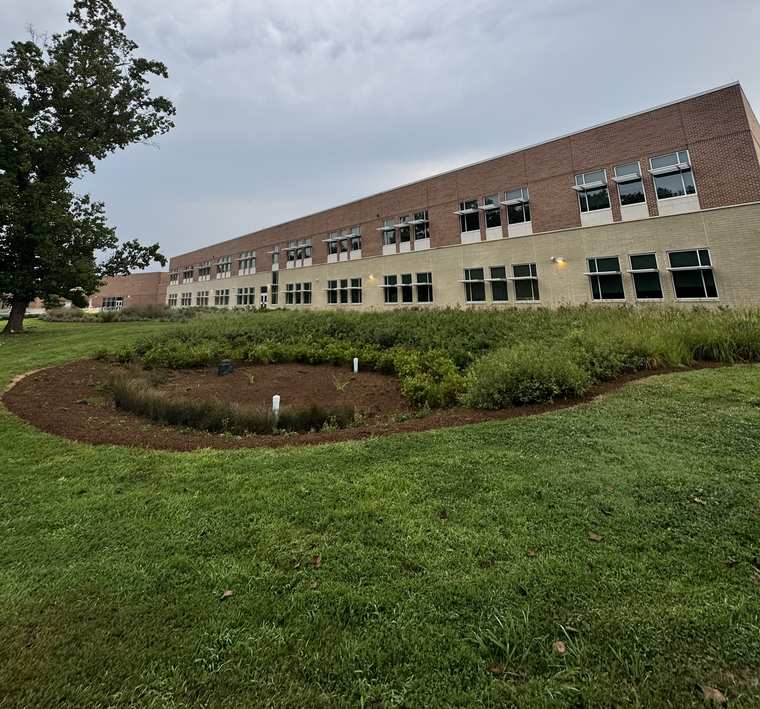
An oval bioretention basin with a fresh mulch ring and full shrubs in front of a large school building
A basin, kept in shapeAn oval bioretention basin on the rounds: shrubs full, mulch ring fresh, banks mowed around it. Baltimore City.
Restoration, Then Rounds

Repaired in June. Grown in by fall.

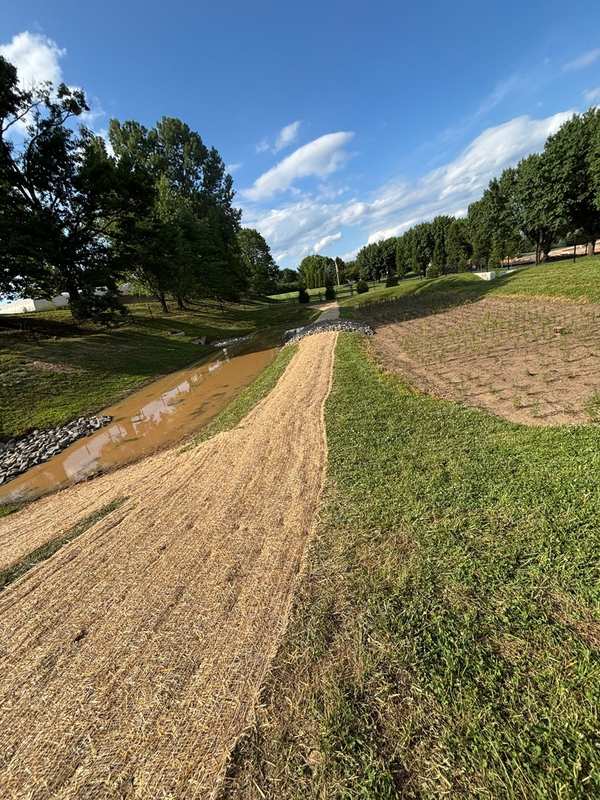
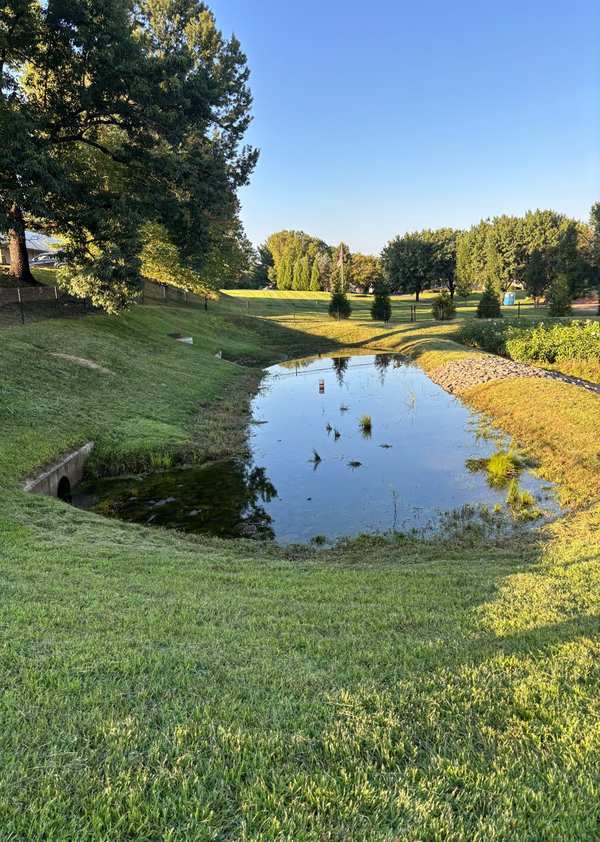
When this pond's overflow failed, the repair wasn't cosmetic. The old riprap came out, roughly 40 tons of fill went back in compacted lifts, the berm was re-graded to its original shape, erosion fabric went down and the riprap was reinstalled. Then the facility went on the maintenance rounds — which is why, three months later, the repair has disappeared into a working pond.

A pond overflow under repair: new riprap, an erosion-mat chute down the rebuilt berm and a freshly seeded slope
Repair week — new riprap and an erosion-mat chute on the rebuilt overflow; the slope beside it freshly seeded. Harford County.
The same stormwater pond three months after the repair: clear still water, mowed green banks and a riprap spillway in golden light
Three months later — the same pond grown in: clear water, mowed banks, the repair invisible. Harford County.
How It Works

From first walk to standing rounds.

Step 1

Walk the facility

We walk the whole facility with you — vegetation, structures, sediment, trouble spots — and give you a straight read on its condition and what it needs. That walk is also how a standalone inspection works.

Step 2

Restore first, if it's degraded

If the facility has slipped past maintenance, it goes back to its engineered plans as a restoration project first. Maintaining a failed facility just polishes the failure.

Step 3

Set the maintenance plan

We write the maintenance plan and the round schedule around your facility — what gets done, how often, and what gets watched. (The plan is ours; the engineering stays with the engineers who designed the facility.)

Step 4

Rounds through the seasons

Vegetation, mulch, cleanouts, structures and turf care, season after season. Facilities don't fail in a day; the rounds are how they don't fail at all.

Step 5

Report & flag

Scope reports with before-and-after photos document the work, and problems — a failing structure, erosion starting, plantings dying back — get flagged while they're still small fixes.

Straight Answers

Common stormwater questions.

Who do you do this for?

Anyone who owns or answers for a stormwater facility: city and county agencies, schools and institutions, state facilities — and HOAs and commercial owners with ponds or BMPs on their property. If it has to function and be documented, it's our kind of work.

Can we hire you for an inspection only?

Yes. A standalone inspection is a service of its own — we walk the facility, assess vegetation, structures and sediment, and report its condition with photos. Inspections also run inside our maintenance contracts, if you'd rather fold them into the rounds.

What happens to a facility nobody maintains?

It stops doing its job, in order: plantings take over or die, sediment and trash choke the structures, and the facility that was built to prevent flooding starts causing it — flooding, erosion, polluted waterways, property damage and mosquito breeding grounds. And the fix gets more expensive every season it's put off.

Why can't our regular lawn crew just mow it?

Because facility turf isn't a lawn. Lawn mowing practices — heavy machines on wet banks, grass cut too short — rut and scalp the slopes a facility depends on. Mowing errors can damage a facility as surely as skipping maintenance altogether.

Our facility is already overgrown. Can you take it on?

Usually, yes — that's what restoration is for. We assess it, bring it back to its engineered plans as a standalone project, then put it on rounds so it stays restored. If a facility is genuinely beyond our scope, we'll tell you that honestly at the walk.

An Honest Fit Check

Is your facility a fit?

A good fit if…

You own or manage a pond, bioretention basin or swale system — agency, institution, HOA or commercial — and you need it functioning, inspection-ready and documented, without building a crew of your own to do it.

Talk to us first if…

Your facility has already failed, or you honestly don't know what condition it's in. Start with an inspection or a walk: we'll tell you whether it's a maintenance plan, a restoration, or something beyond our scope.

Not what we do

Residential yard drainage — that's our drainage service, a different crew conversation. Engineering design — we write maintenance plans and restore facilities to their engineered plans; we don't design or stamp them. And no pools or irrigation.

4.9★ on Google · 36 reviews·Woman-Owned · Certified Small Business·MHIC 112954·40+ years in Harford County
Serving Baltimore City · Baltimore County · Harford County — plus SHA & MDOT facility work.

Ready to talk about your facility?

An inspection, a restoration, or a standing round — it starts with a walk.

Contact Four SeasonsCall 443.390.YARD (9273)